
Talent Training Programme
Kisumu Talent Training Programme
The KijaniSpace Kisumu Talent Training Programme is a three-month remote learning journey for motivated students, early-career professionals, and innovators who want to work at the intersection of space technology, digital systems, and sustainable agriculture. The programme is implemented within the Horizon Europe KijaniSpace framework.
Running from 21 May 2026 to 6 August 2026, the programme is delivered primarily online. The only on-site component is a focused Hackathon in July 2026, hosted at LakeHub in Kisumu, Kenya, where participants collaborate in an intensive innovation sprint with experts and stakeholders from the Lake Victoria region and Europe.
The programme is free of charge and delivered within the Horizon Europe KijaniSpace framework to strengthen capacity and practical innovation skills in space-enabled digital agriculture.
During the on-site Hackathon at LakeHub, catering will be provided. Participants are expected to arrange and cover their own travel and accommodation costs.
The programme emphasizes practical application. Participants learn how to transform Earth Observation data, Internet of Things (IoT) sensor inputs, and local knowledge into operational decision-support solutions for farms and aquaculture systems. The emphasis is on applying satellite and sensor data in real pilot contexts.
Workload and Structure
Participants are expected to commit approximately 3-6 hours per week for online sessions, team collaboration, and practical assignments. The programme combines mentoring, applied exercises, teamwork, and structured online workshops.
During the programme, participants will:
- Work with Copernicus satellite data and in-situ IoT sensors
- Integrate geospatial and field-level datasets
- Develop irrigation and aquaculture decision-support concepts
- Apply AI-assisted analytics in agricultural contexts
- Collaborate in international, interdisciplinary teams
Participants engage with farmers, researchers, and technology providers across Europe and Africa, gaining insight into real-world constraints, data governance, and responsible innovation.
Expected Output
By the end of the programme, each participant will deliver:
- A prototype, analytical model, algorithm, or decision-support concept
- A short implementation brief or concept note describing practical applicability
- A presentation of results during the final programme session
Solutions must demonstrate operational feasibility and relevance to real agricultural use cases.
Completion of the Programme
Participants who successfully complete the programme will receive a Certificate of Successful Completion issued within the KijaniSpace framework.
To qualify, participants must:
- Attend at least 80% of the online sessions, and
- Present a prototype, analytical model, algorithm, or decision-support concept developed during the programme, including work advanced during the Hackathon.
Prequalification Criteria
Applicants should:
- Have a background in agriculture, environmental sciences, geoinformatics, ICT, engineering, data science, or related fields
- Possess basic digital and data-handling skills
- Be motivated to work in interdisciplinary and international teams
- Commit to active participation throughout the full three-month programme, including the Hackathon.
Prior experience with GIS, coding, satellite data, or IoT is an advantage but not mandatory. Curiosity, analytical thinking, and reliability are essential.
As participation is free, selection will be competitive and based on motivation, relevance of background, and commitment.
Approximately 60 participants will be selected. The final cohort will ensure a balanced mix of technical and agricultural expertise to support interdisciplinary teamwork.
The Talent Training Programme
A series of training sessions is how the Talent Training Programme is delivered, and these are held on Thursdays, starting at 2 pm East African Time (EAT).
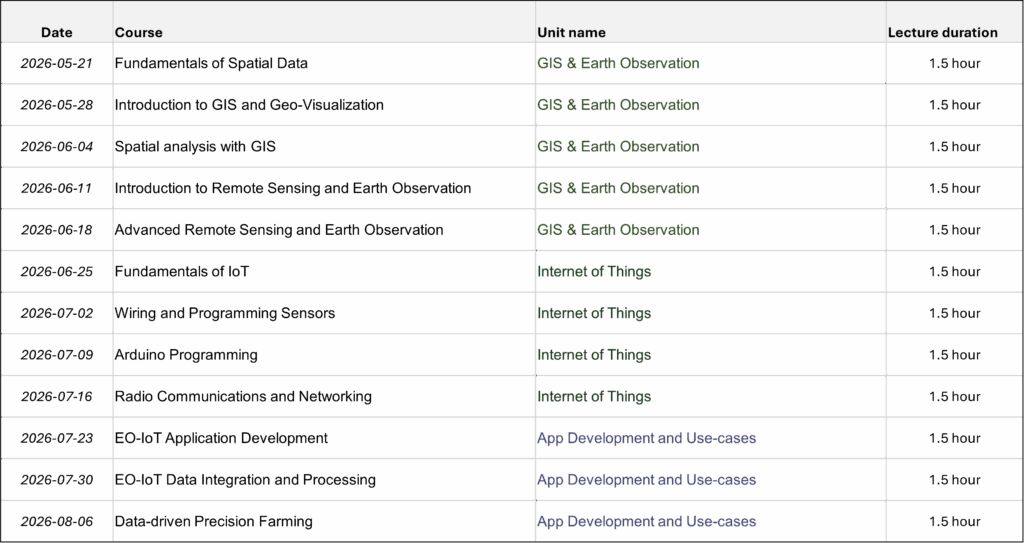
Unit 1 GIS & Earth Observation: Ever wondered how satellites see the world or how digital maps are actually made? Over five weeks (starting May 22), we’ll take you from the basics of spatial data to the cutting edge of satellite monitoring. You’ll learn to visualize geographic data and analyze the Earth from above.
Unit 2 Internet of Things (IoT): If you’ve ever wanted to build your own “smart” gadgets, this is your moment. Starting June 26, this four-week unit dives into the Internet of Things. You’ll get hands-on with electronics, learning how to wire sensors, master Arduino programming, and set up radio communications. It’s the chance to move from being a tech user to being a tech creator.
Unit 3 App Development and Use-cases: This is where all the pieces of the puzzle come together. Starting July 24, this three-week finale focuses on turning data into real-world solutions. You’ll explore how to combine Earth Observation and IoT data to build functional apps, specifically looking at how they can revolutionize precision farming.
Contact and Further Information
Implemented within the KijaniSpace Horizon Europe and EU Agency for the Space Programme (EUSPA) project. For detailed information about the KijaniSpace initiative, visit: www.kijanispace.eu
For questions regarding the Talent Training Programme, application process, or participation requirements, please contact
Margaret Sandra
LakeHub, Kisumu, Kenya
margaretsandra@lakehub.co.ke
Key Dates
The application deadline has been extended to 7 April 2026 at 16:00 EAT.
Selection & acceptance notification: 30 April 2026
Programme start: 21 May 2026
On-site Hackathon in LakeHub, Kisumu, Kenya: July 2026
Programme end: 6 August 2026
How to Apply
Applications are submitted via Google Forms.
Applicants can look at the application questions in advance from this PDF.
FAQs
Motivated students, early-career professionals, and innovators interested in space tech, digital systems, and sustainable agriculture.
Agriculture, environmental sciences, geoinformatics, ICT, engineering, data science, or related fields.
Not required, but it’s an advantage. Curiosity, analytical thinking, and reliability matter.
No, the programme is free of charge. However, participants are responsible for covering the costs of travel and accommodation for the mandatory hackathon in Kisumu.
Online-first. Expect ~3–6 hours per week for sessions, teamwork, and assignments.
Yes. A focused Hackathon in July 2026 at LakeHub in Kisumu, Kenya.
Catering will be provided during the on-site hackathon, but participants will need to arrange and cover the cost of their own travel and accommodation.
A prototype/ model/ algorithm/ decision-support concept + short concept note + final presentation.
Yes, if you attend at least 80% of sessions and present your project.
~60 participants; selection is competitive based on motivation, background relevance, and commitment. Cohort aims for a balanced mix of technical and agricultural expertise.
Applications via Google Forms which link is on this website
Margaret Sandra, LakeHub, Kisumu, Kenya. Margaret’s contact data is on this website.